Page contents
Definition: what is head loss?
Head loss is the decrease of the hydraulic head, i.e. of the mechanical energy per unit weight of fluid, between two points of a flow. It is irreversible: pressure energy is turned into heat by viscous friction, wall roughness and the turbulence created by changes of section and direction. It is expressed either as a pressure (pascals, millibars) or as a height of fluid column (metres of water column), the two being linked by ΔP = ρ g ΔH. It is what a pump or a fan has to make up to maintain the flow.
Head loss in Bernoulli's equation
Between the upstream point A and the downstream point B of a pipe, the head H decreases by the head loss ΔH:
From head of fluid to pressure, and general form of any head loss:
- ΔH: head loss in metres of fluid column (metres of water for water)
- ΔP: pressure drop in pascals (Pa); ρ: density, in kg/m³; g = 9.81 m/s²
- P, V, z: pressure, velocity and elevation at A and B (see Bernoulli's theorem)
- K: dimensionless loss coefficient: λ L/D for a straight pipe (major loss), ζ for a fitting (minor loss)
- ρ V² / 2: dynamic pressure, in Pa
Head loss units
| Unit | In pascals | In metres of water column |
|---|---|---|
| 1 bar | 100,000 Pa | 10.2 m H₂O |
| 1 mbar = 1 hPa | 100 Pa | 1.02 cm H₂O |
| 1 m H₂O (metre of water column) | 9,790 Pa (9,810 at 4 °C) | 1 m H₂O |
| 1 mm H₂O | 9.8 Pa | 0.001 m H₂O |
| 1 psi | 6,895 Pa | 0.70 m H₂O |
| 1 kPa | 1,000 Pa | 0.102 m H₂O |
Detailed explanations and calculation in Mecaflux
See also:
- The calculation of major losses air water hydraulic aeraulic pressure drops.
- The calculation of minor losses air water hydraulic aeraulic pressures drop.
- Minor loss coefficient (air hydraulic aeraulic water) with mecaflux pro 3D
- Minor loss coefficient (air water hydraulic aeraulic) with standard mecaflux
Definition pressure drops head loss air water hydraulic aeraulic:
The losses in the pipes and networks aeraulic or hydraulic (air water gas) designates the irreversible loss of pressure energy, that undergoes a liquid or a gas as it passes through a conduit, or another fitting of fluid network .
these energy losses related to the fluid velocity (low speed = low pressure drop), is caused by the conversion into heat of the internal friction caused by:
- the viscosity of the fluid (a perfect fluid, without viscosity, does not generate a pressure drop),
- the roughness of the walls,
- the speed variations
- and changes in direction of the fluid.
L'unité de la perte de charge est une pression (pascals,bars...)The unit pressure drop is a pressure (Pascal, bars ...) or a height of water column that produces a hydrostatic head (head loss) (hydrostatic pressure) equivalent.The term "head loss" therefore means "loss of hydrostatic head." From this definition we can already say that the losses in the networks are important if:
- The fluid velocity is high and the roughness is important.
- Speed variation due to the change of section is important and sudden.
- the change of direction is important and sudden.
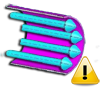
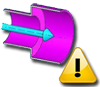

- the speed is low and surfaces are smooth.
- the speed variation due to a change in section is gradual and low.
- the change of direction is low and progressive.

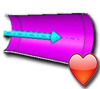

- There are 2 types of pressure losses:
- The major head loss , representing frictional head loss in the pipes. They are caused by the fluid viscosity.They depend on the degree of turbulence (described by the Reynolds number)..
- The minor head loss, are the result of changes in speed and direction changes of the fluid caused by the shapes and obstacles encountered by the fluid passing through an object: Cones, elbows, grids, racordements, junctions ...
In reality, these two types of pressure losses may not be separate, and in a rounded elbow, it is some minor head loss due to change of direction and a part of major load loss due to friction along the length of conduit formed by the elbow. An addition of the two pressure losses may be necessary if the friction surfaces are important (a coil constituted of elbows) But usually, the major head loss are Neglected for fittings or other networks elements.
The coefficient of head loss:
The pressure drop coefficient is a unitless value which calculates the pressure drop as a function of the dynamic pressure of the fluid.
- Dynamic pressure= 0.5 x Density(kg/m3) x Velocity²(m/sec)
Since there are two types of losses, there are two types of coefficients head loss:
 Major head loss coefficient.
 Minor head loss coefficient.
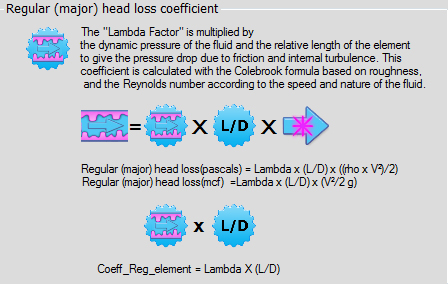
There are various formulas to determine themajor loss coefficient ,The choice of formula depends on the flow regimewhich is estimated with the Reynolds number.
- https://www.mecaflux.com/en/poiseuille.htm
- https://www.mecaflux.com/en/blasius.htm
- https://www.mecaflux.com/en/blench.htm
- https://www.mecaflux.com/en/colebrook.htm
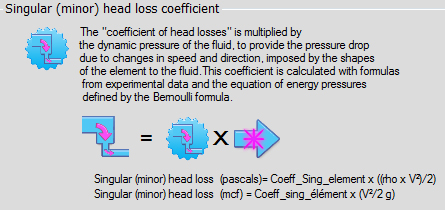
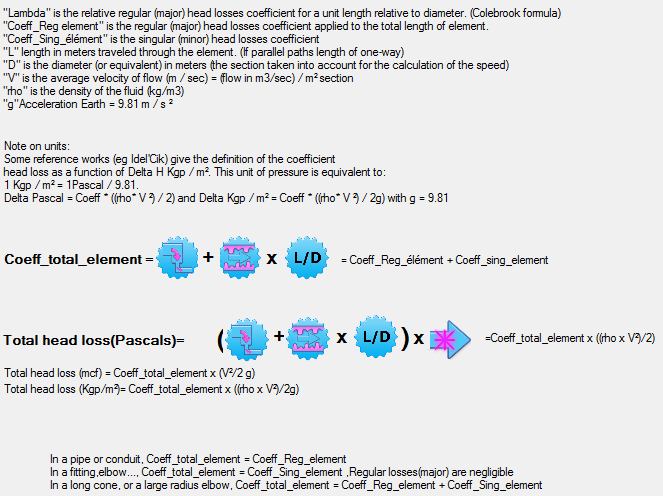
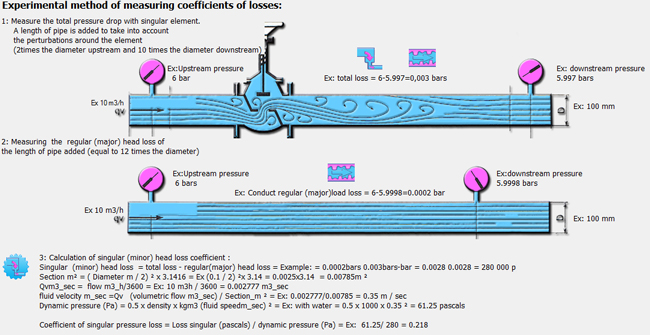
A description of the method of calculation of the coefficient of head loss based on a measure of loss (Image taken from pro3D mecaflux software)
For more information on head loss and pressure loss factors:
The calculation of major head loss. (major pressure drop)
The calculation of minor head loss. (minor pressure drop)
Determine the minor head loss coefficient with mecaflux 3D
Determine the minor head loss coefficient with mecaflux standard
Frequently asked questions
Why do we speak of "head" and "head loss"?
The head is the height H = P/ρg + V²/2g + z of Bernoulli's theorem, which represents the total energy of the fluid per unit weight, expressed in metres. In a real flow this height decreases in the direction of flow: this is the head loss, measurable as the level difference between two piezometer tubes.
How do I convert a pressure drop in pascals to metres of water column?
Divide by ρ g: ΔH = ΔP / (ρ g). For water, 1,000 Pa corresponds to 0.102 m, and 1 bar to 10.2 m. For air (ρ = 1.2 kg/m³), 100 Pa represents 8.5 m of air but only 10 mm of water column, the unit used in ventilation.
Does head loss depend on the fluid?
Yes, through viscosity, which sets the Reynolds number and hence the friction factor λ, and through density when it is expressed in pascals. Expressed as a head of fluid, it depends only on geometry, velocity and λ.
How do I calculate the head loss of my own installation?
The online calculators on this site handle a straight pipe or a single fitting; Mecaflux Standard adds up all the losses of your network in the inventory and finds the pump operating point, and Mecaflux Pro3D models branched and looped networks in 3D. For a network to diagnose, size or justify, Mecaflux carries out the study of your project and delivers the calculation report, or offers training on the software applied to your own installation.